
Creating and Handling Fire 10.000 BCE
Stone Age Survival Game Development Blog

Two cavemen are watching a bush burn after a lightning strike. One turns to the other and says, “I don’t know, Grog. It’s a great invention, but the ‘Terms and Conditions’ say if you touch it, you die.”
Creating fire is more than 400.000 years old practice. By the time of the Upper Paleolithic, it was something commonplace.
The myth that fire was mostly “caught” and then kept alive at all costs seems to be largely a myth.
The fire drill
Fire can be started by creating friction, heat and catching this heat into easily flammable materials like dried leaves, dry bark, cattail fluff, dried moss, birds nest etc.
Medium-hardness wood is best, such as cedar, cottonwood, or willow for both the spindle and board, which must be perfectly dry. In general, any dry wood would work.


It seems relatively easy to create a fire with bow-drill. Something to try out this year.

Strike-a-light
Basically it is hitting two rocks together to create a spark. Typically, a piece of flint or high-silica stone was struck against iron pyrite, marcasite, magnetite, hematite.

Strike-a-lights from French Neolithic sites: (a, b) Avize “ les Dimaines, “ Marne; (c, e) Nanteuil-l?s-Meaux “ le Poteau Vert, “ Seine-et-Marne; (d) Vignely “ La Porte aux Bergers, “ Seine-et-Marne. Figure 7d by P. Allard.
The finds are from couple of thousands of years later but gives general idea of how these “lighters” looked like.

This is the best video to explain how it works
Keeping the fire
Campfire was a simple temporary fire just on the ground. If possible, to a location covered from rainfall.

Stone-Lined or Ringed Hearth
The purpose of the circularly placed stones was to contain the fire and the stones stored the heat - the first “battery” if you will.

Pitted / Depressed / Scraped Hearths
A pit protects the embers from wind and traps a “pool” of hot coals at the bottom. Found all over the world, this was another “common sense” approach.

The stone-lining and pit hearth was also often combined.
The “Air-Draft” or Ventilated Hearth
Found in more sophisticated dwellings (like the mammoth-bone huts of Eastern Europe or Lazareth cave in France), these hearths were placed strategically near entrances or had small “channels” dug to pull oxygen toward the base of the fire.

The “smoking rack” Hearth
Used to smoke meat or gathered food items so they can be stored for longer period of times. The smoke killed the bacteria and remove liquid from the food source. The smoking to preserve meat is claimed to be more than a million year old tradition.
https://popular-archaeology.com/article/researchers-estimate-that-early-humans-began-smoking-meat-to-extend-its-shelf-life-as-long-as-a-million-years-ago/


Freshly cut wood has more than 50% humidity content, compared to 10%..20% of air dried. I wonder if people back then figured it out that it is not great if most of the energy goes into boiling the water out of the wood, instead of giving you heat.
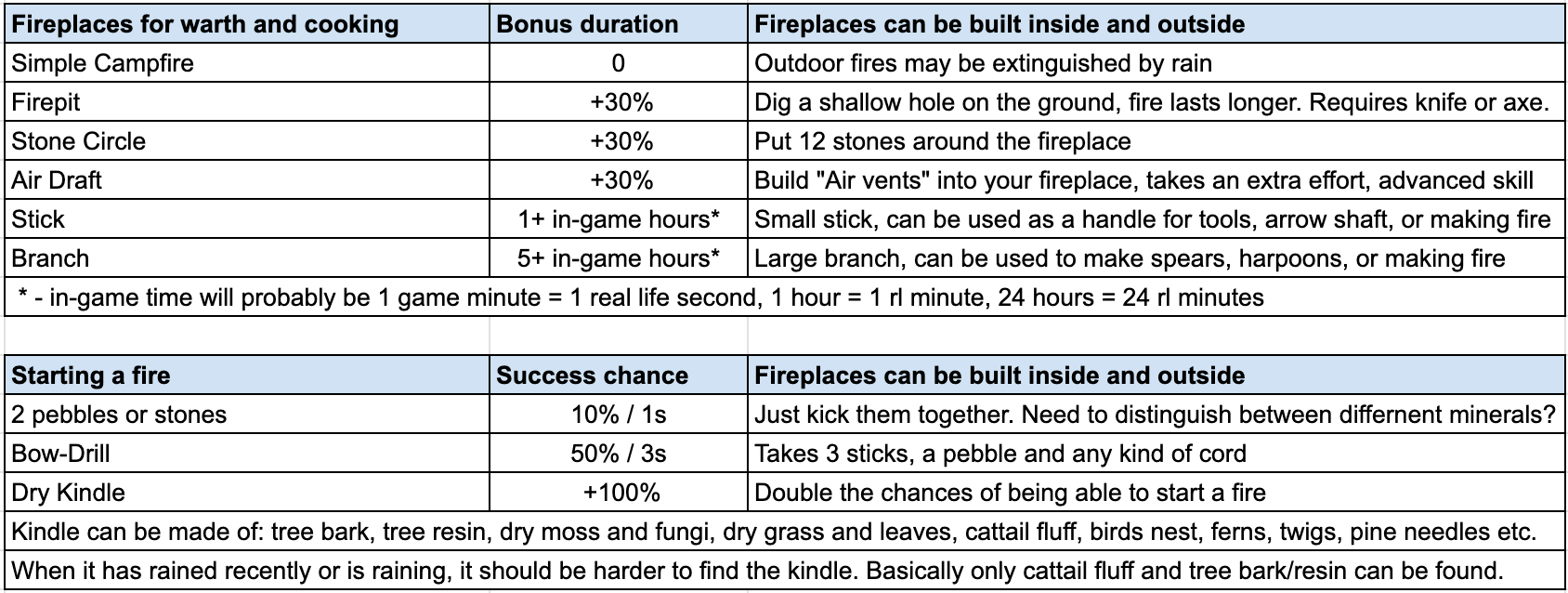
So this is what should be in the game:
Next: Stone Age Workstations